Exclusive No-Deposit Casino Bonus UK 2026: What the Licence Test and the 10x Wagering Cap Mean for the Player
A no-deposit bonus sounds like the cleanest deal in iGaming: money on the account, no money out. The licence test under the Gambling Act 2005, the 10x wagering cap in force since 19 December 2025, and the verification rules that apply before the first spin decide whether the deal is what it appears to be. This page walks the reader through those rules, then through the ten Gambling Commission-licensed brands the register’s domain list points to as active remote casino operators, and ends by costing the bonus the way the formula costs it.

Current as of 7 November 2026 against the Gambling Commission’s public register of remote casino operating licences.
Table of Contents
- Incentive Structures Around No-Deposit Offers: How the UK Market Frames “Exclusive”
- Foundational Mechanics: How the No-Deposit Bonus Actually Pays Out
- Jurisdictional Frame: The Gambling Commission’s Licence Test
- Stake Limits, Age Bands and the Game Cycle
- Self-Exclusion, Vulnerability Checks and the Mandatory Safety Net
- Payments and the Withdrawal Path on a No-Deposit Win
- What the 10x Wagering Cap Looks Like in Practice: A Costed Scenario
- Bonus and Free-Spin Mechanics Under the December 2025 Rules
- Landsca
- How the Ten Brands Compare on the Things the Register Records
- Picking a Brand for a No-Deposit Reader
- Where the Cost of the Bonus Hides
- The Verification Step as the Real Gate
- What Happens to a No-Deposit Win Without Verification
- The Offshore Counterfactual
- Reading the Licence Number: A Practical Walkthrough
- Closing the Loop on the Bonus
- Frequently Asked Questions About UK No-Deposit Casino Bonuses
Incentive Structures Around No-Deposit Offers: How the UK Market Frames “Exclusive”
“Exclusive” in this market does not mean what it says on most affiliate landing pages. An exclusive no-deposit bonus is, in practice, a small credit — bonus cash, free spins, or a hybrid of both — granted by a Gambling Commission-licensed casino to a new account holder before any deposit is made. The exclusivity claim usually attaches to one of three things: a partnership with an affiliate that funnels traffic through a tracked link, a time-limited launch offer that one operator extends to a defined cohort, or a sister-site arrangement in which one licence account runs several brands with slightly different terms.
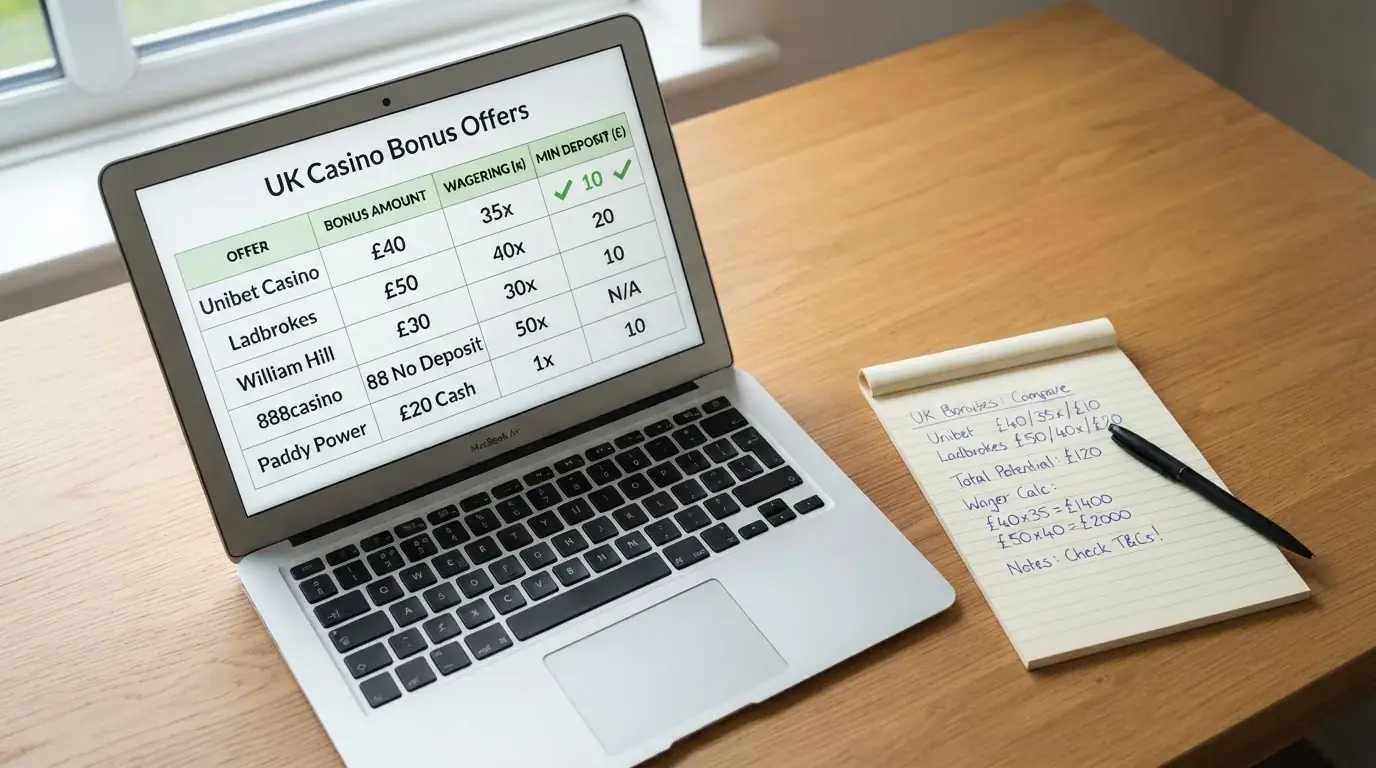
What the marketing never quite names is that the bonus still costs the player something. The credit is not cash. It is a constrained balance that carries a wagering requirement, a maximum conversion to withdrawable funds, an expiry clock, and the full identity-verification gauntlet that every UK-licensed site must run before the first payout. The “no deposit” label refers to the moment the account is opened, not to what happens afterwards.
The Gambling Commission’s public register, downloadable as a CSV or Excel file, listed 139 businesses holding an active remote casino operating licence on 18 September 2026. The register is the only authoritative test of whether a brand is licensed to take UK customers; the licence number on a casino’s footer should be searchable there within seconds, and if it is not, the rest of the page is irrelevant. Several brands on the register share a single licence account — Ladbrokes, Coral and Gala Bingo all sit under LC International Limited (account 54743), for example — so a reader looking for independent operators will find fewer than the headline count.
The register’s domain list recorded 1,065 active domain entries and 361 white-label entries on the same date. A white-label site trades under another company’s licence: the same licence account, the same compliance team, the same terms of business, a different brand on the door. From the player’s standpoint, the difference between an active entry and a white-label entry is mostly cosmetic; the protection regime is identical because the licence is identical.
Foundational Mechanics: How the No-Deposit Bonus Actually Pays Out
A no-deposit bonus arrives in one of two shapes. The first is bonus cash — for example, £10 credited to a new account, playable on a defined list of slots or, more rarely, on the full casino. The second is free spins — typically 20 to 50 spins on a named slot, with each spin’s value fixed by the operator (commonly £0.10). Hybrid packages exist, but they are rarer under the December 2025 rules: mixed-product bonuses, where a sports bet unlocks casino credit, were banned as part of the same package that capped wagering at 10x.
Either shape is governed by three terms that determine what the player actually ends up with.
The wagering requirement is the multiplier the player must stake through before any winnings become withdrawable. The 10x cap that came into force on 19 December 2025 means that a £10 bonus must be staked through £100 of qualifying play before the resulting balance can be withdrawn. Free spins carry an equivalent cap on the winnings they generate — the same 10x rule applies to the bonus component of any offer, however it is constructed. A player who hits a substantial win on the very first spin still has to grind through the requirement; the win does not shortcut the multiplier.
The maximum conversion is the ceiling on what the bonus can pay out. Some no-deposit offers cap withdrawable winnings from the bonus at a fixed amount (frequently £50 or £100); anything above that is forfeit. Others have no cap, in which case the wagering requirement itself is the constraint. The terms are always in the small print, and the small print is always binding.
The expiry clock decides how long the player has to clear the requirement. A 7-day window is common; some offers extend to 30 days. Unused bonus funds and any winnings tied to them expire on the clock; the player does not get to bankroll the bonus into next month.
The verification rules sit alongside these terms rather than inside them. Since 7 May 2019, every UK-licensed operator has had to verify the player’s name, address and date of birth before the first deposit or any play. A no-deposit bonus does not exempt the player from the check — the verification runs before the first spin, and any withdrawal is gated by it. A player who wins on a no-deposit bonus and then fails the verification step loses the winnings and the bonus. This is the part of the deal that the marketing rarely highlights.
Jurisdictional Frame: The Gambling Commission’s Licence Test
A remote casino operating licence is the prerequisite for offering any bonus — no-deposit or otherwise — to a customer in Great Britain. The Gambling Act 2005 covers England, Scotland and Wales; Northern Ireland sits under separate legislation. The Gambling (Licensing and Advertising) Act 2014 closed the offshore loophole: any operator taking customers in Great Britain needs a Commission licence regardless of where it is incorporated. A Curaçao, Malta or Gibraltar licence is a complement at best; it is never a substitute.

The licence number itself has a recognisable shape. A remote casino licence on the public register takes the form account-R-number–suffix — for example, 038905-R-319430-022. The leading six digits repeat the licence holder’s account number; the “R” marks the licence as remote (online); the suffix increments as the Commission issues variations to the same account. A reader who wants to check a licence can paste the number into the register’s search tool and see the licence holder, the licence status, the domains attached to it, and any conditions or reviews the Commission has logged.
Providing gambling to people in Great Britain without a licence is an offence under section 33 of the Gambling Act 2005. The Commission disrupts unlicensed sites through cease-and-desist notices, search-engine delisting referrals, and payment and hosting referrals; it does not have the power to block at ISP level. The penalty falls on the operator, not the player. What the player loses on an unlicensed site is the protection framework — no GAMSTOP, no Commission complaints route, no approved alternative dispute resolution.
Tax is the part that surprises readers who assume gambling winnings carry a levy. Players pay no tax on gambling winnings in the UK. Operators pay Remote Gaming Duty, which rose from 21% to 40% from 1 April 2026; the rate change affects operator economics, not what the player takes home. A £500 withdrawable win from a no-deposit bonus is a £500 win in the player’s pocket, subject to the standard anti-money-laundering checks the operator is required to run.
Stake Limits, Age Bands and the Game Cycle
The Commission’s stake-limit rules, in force since the spring of 2025, draw a hard line on what an adult player can put through one spin of an online slot. For players aged 25 and over, the maximum stake per game cycle is £5 (from 9 April 2025). For players aged 18 to 24, the maximum is £2 (from 21 May 2025). The lower band for younger adults is a deliberate harm-reduction measure: the Commission estimated in 2018 that 22% of online gamblers who used credit cards to gamble were classed as problem gamblers, and the stake differential is one of several tools aimed at the cohort the data flagged.
A “game cycle” is the technical unit the rule applies to. For a slot, it is one full spin from wager to result display. The stake limit is per cycle, not per session: a player can run as many £5 spins as their bankroll supports, but cannot bundle multiple cycles into one larger wager. Auto-play is banned (since 31 October 2021), a single spin may not resolve faster than 2.5 seconds, and “losses disguised as wins” — slot presentations that celebrate a payout smaller than the stake — are prohibited.
The credit-card ban, in force since 14 April 2020, applies across all online and offline gambling products in Great Britain except non-remote lotteries paid for face-to-face. Debit cards and bank transfers are unaffected; credit cards routed through e-wallets are caught by the ban. The Commission’s estimate at the time was that around 800,000 UK consumers used credit cards to gamble in 2018; the rule was framed as closing a path that let players borrow their way into losses they could not repay.
Self-Exclusion, Vulnerability Checks and the Mandatory Safety Net
GAMSTOP is the national online self-exclusion scheme, and it has been a mandatory condition of every online operating licence since 31 March 2020. A player who registers with GAMSTOP chooses an exclusion period of six months, one year or five years; the registration cannot be cancelled early, and every UK-licensed operator is required to check new accounts against the GAMSTOP database before allowing play. A no-deposit bonus is not a way around GAMSTOP — the check runs at the same point as for a funded account, and a self-excluded player cannot claim.
Financial vulnerability checks, in force from 28 February 2025, run at the £150 net-deposit threshold in a rolling 30-day window using publicly available data. The check is light-touch and triggered automatically; it does not require the player to submit documents at that point. The Commission has signalled wider financial risk assessments to come but has not put them in force as of the current register snapshot. A no-deposit bonus does not push a player below the £150 trigger — by definition, no money has been deposited — but the framework still applies once the player moves to a funded account.
Before the first deposit at any licensed operator, the player is prompted to set a financial limit. The rule, in force from 31 October 2025, requires the operator to surface a limit-setting tool before the deposit button is enabled. The player can set a deposit ceiling, a loss ceiling, a session-time ceiling, or any combination; the limits are not the operator’s defaults but the player’s choice. A no-deposit bonus sits one step before this prompt — the player can claim and play the bonus without setting a limit, because no deposit is being made — but the prompt will fire the moment a deposit is attempted.
The National Gambling Helpline (run by GamCare) and GambleAware are the two signposted support routes on every licensed site. The helpline number, the live-chat link, and a self-exclusion entry point must be reachable from the responsible-gambling page of every operator; the Commission checks this in its compliance reviews. A reader who feels their play is drifting is one click away from each of these.
Payments and the Withdrawal Path on a No-Deposit Win
A no-deposit bonus generates no deposit but, if the player wins and clears the wagering requirement, it does generate a withdrawal. The withdrawal runs through the same rails as a funded play: debit card, bank transfer via the Faster Payments Service, or an e-wallet that supports gambling transactions in the UK.
Faster Payments, operated by Pay.UK, has been live since 2008 and runs 24 hours a day, seven days a week. Most payments arrive instantly or within a couple of minutes; the scheme allows up to two hours for occasional delays, and individual banks can impose lower per-transaction limits than the scheme’s £1,000,000 ceiling. A withdrawal from a licensed casino typically lands in the player’s bank account the same day, provided the verification step has already been cleared.
The verification step is the bottleneck most players underestimate. A first withdrawal triggers full know-your-customer documentation: proof of identity (passport or driving licence), proof of address (utility bill or bank statement, usually within the last three months), and proof of payment method (a photo of the card used, with the middle digits redacted). The operator has a window to review; the Commission does not set a fixed turnaround, but most operators clear the check within 24 to 72 hours. The first withdrawal is slower than the tenth; subsequent withdrawals, on the same verified account, clear faster.
Apple Pay is a deposit option at several licensed operators — the card-tokenisation model and the dynamic security code are designed for exactly this kind of transaction — but the player’s underlying card still has to be a UK-issued debit card (credit cards are banned for gambling). AstroPay, an electronic money institution authorised in the UK by the Financial Conduct Authority under the Electronic Money Regulations 2011, is also available at some operators; the brand serves users across markets including the UK and runs separate regulated entities in the Isle of Man, Brazil and Denmark. Both options work for deposits; neither changes the verification step.
What the 10x Wagering Cap Looks Like in Practice: A Costed Scenario
The wagering-turnover-band calculation the Commission’s December 2025 rules enable is straightforward in arithmetic and revealing in what it implies about time and money.
Take a £10 no-deposit bonus, credited on a new account, with a 10x wagering requirement. The required turnover is £10 × 10 = £100 of qualifying play. At a slot stake of £0.10 per spin — a common configuration for free-spin equivalents and a conservative stake for bonus-cash play — that turnover translates to £100 ÷ £0.10 = 1,000 spins. At a 5-second interval per spin, that is 1,000 × 5 = 5,000 seconds, or roughly 1 hour and 23 minutes of play.
At a higher stake of £0.50 per spin, the same £100 turnover requires 200 spins, or about 17 minutes. At a £5 stake — the maximum for a player aged 25 or over — it requires 20 spins, or just under two minutes. The £2 stake for players aged 18 to 24 doubles that to 40 spins.
The result is a band rather than a single figure: clearing a £10 bonus takes between roughly 17 minutes and an hour and a half of play, depending on how the player sizes each spin. The condition that drives the band is stake size, and the constraint that bounds it on both ends is the stake-limit rule the Commission set for age bands.
This analysis produces a clear takeaway: it tells the player that “no deposit” is not “no time”, and that the time the bonus consumes depends entirely on the stake the player chooses. A player who treats the bonus as a quick look around the casino can clear it in minutes; a player who treats it as extended play on a low stake will spend an hour and a half on what was supposed to be a freebie. Neither player has deposited a penny. Both have spent the time.
The same arithmetic scales with the bonus amount. A £20 no-deposit bonus at 10x wagering requires £200 of turnover; at £0.10 per spin, that is 2,000 spins, or about 2 hours and 47 minutes. The wagering cap compresses the worst-case scenarios the pre-2025 market sometimes offered — 40x or 50x wagering was not unheard of — and the result is a shorter play commitment for the same bonus headline.
Bonus and Free-Spin Mechanics Under the December 2025 Rules
The package of reforms that took effect on 19 December 2025 did two things that directly shape the no-deposit market. First, it capped wagering requirements at 10x for any bonus offered to a UK customer. Second, it banned mixed-product bonuses — the kind of promotion where a sportsbook bet unlocks casino credit, or where a casino deposit unlocks bingo tickets. The two rules together simplify the comparison: every bonus the player meets, from any licensed operator, carries the same wagering ceiling.
Free spins sit under the same 10x cap on the bonus component of any offer. A package of 50 free spins at £0.10 per spin on a named slot generates up to £5 of bonus value before wagering; the 10x requirement applies to that £5, not to the £5 nominal value of the spins themselves. The distinction matters because the marketing tends to print the gross figure (£5 of spins) and elide the bonus-component arithmetic (the £5 is a starting point for a £50 turnover requirement). Both numbers are in the small print; the player should read both before claiming.
Game contribution is the third mechanic the player should understand. Slots typically contribute 100% of stake value to the wagering requirement; table games and live casino often contribute 10% or 0%. A player who clears a bonus on roulette is wagering ten times the headline figure to achieve the same turnover. The terms always specify the contribution table; the table is part of the contract.
Maximum bet during bonus play is a fourth mechanic, and one of the most commonly breached terms by accident. Most licensed operators cap the stake per spin at £5 (or £2 for 18-24-year-olds, aligning with the age-band stake limit) while a bonus is active. A player who spins above the cap risks forfeiting the bonus and any winnings tied to it. The cap is automatic at some operators and a manual check at others; either way, the player should assume it is enforced.
Landsca
| Brand | Licence holder | GB remote casino licence | Domain status on the register |
|---|---|---|---|
| Bet365 | Hillside (UK Gaming) ENC | 055149-R-331499-004 | Active |
| Coral | LC International Limited | 054743-R-330863-014 | Active |
| Betfair | PPB Games Limited | 039411-R-319335-010 | Active |
| Unibet | Platinum Gaming Limited | 045322-R-324275-019 | Active |
| Betfred | Petfre (Gibraltar) Limited | 039544-R-319290-010 | Active |
| PokerStars | Stars Interactive Limited | 039108-R-319334-026 | Active |
| Jackpotjoy | Gamesys Operations Limited | 038905-R-319430-022 | Active |
| Gala Bingo | LC International Limited | 054743-R-330863-014 | Active |
| Sky Vegas | Bonne Terre Gaming Limited | 065519-R-339675-002 | Active |
| Grosvenor Casinos | Rank Interactive (Gibraltar) Limited | 057924-R-334666-005 | Active |
Bet365 — The Largest Active Licence on the Register
Bet365 runs under Hillside (UK Gaming) ENC, account 55149, on remote casino operating licence 055149-R-331499-004. The brand is the highest-profile name on the register and one of the longest-established remote operators in the UK. Its scale translates to a wide slots catalogue and a deep payments menu; its licence file is one of the more frequently varied, reflecting the volume of product change the brand runs.
The brand’s offer set is heavily deposit-led, and the no-deposit segment is a thin slice of it. Where a no-deposit offer runs, it tends to be small (£5 to £10 of bonus cash or a free-spin equivalent) and tightly scoped. The 10x wagering cap applies; the verification rules apply; the stake limits apply. A player comparing Bet365 to smaller brands is comparing depth of catalogue to breadth of promotional activity, and on the no-deposit axis the smaller brands are usually more active.
For a player who values catalogue and payment depth over the size of the introductory credit, Bet365 is the more durable relationship. For a player whose priority is the largest no-deposit headline, the brand is unlikely to lead the field.
Coral — One Licence, Multiple Doors
Coral runs under LC International Limited, account 54743, on remote casino operating licence 054743-R-330863-014. The same licence account runs Gala Bingo — the two brands share not just a corporate parent but a single regulatory filing — which is worth knowing for any reader comparing “independent” operators. The terms a player accepts at Coral are the same terms a player accepts at Gala Bingo, with brand-level variation only in presentation and promotional cadence.
Coral’s no-deposit activity has historically been modest and has tended to favour sportsbook-adjacent free bets rather than casino credit. Under the December 2025 rules that mixed-product path is closed: any no-deposit offer Coral now extends is casino-only and capped at 10x. A player who lands on Coral via a sportsbook promotion will not see that promotion convert into casino spins.
The verdict for the no-deposit reader is straightforward: Coral is a brand to know is licensed and available, not a brand to chase for the headline introductory offer.
Betfair — A Poker-Exchange Heritage in a Casino Wrapper
Betfair runs under PPB Games Limited, account 39411, on remote casino operating licence 039411-R-319335-010. The brand’s heritage is the betting exchange, and the casino product sits inside that wider operation. The licence is long-standing and the register entry is active; the casino product carries the same player protections as the exchange.
No-deposit offers at Betfair have been intermittent in recent years, and where they appear they tend to be small and tightly time-limited. The casino’s strength is its exchange integration rather than its slots catalogue. A player looking for a no-deposit headline is unlikely to find one at Betfair that they cannot find at a brand more focused on casino play.
Unibet — A Single Licence, a Quietly Broad Casino
Unibet runs under Platinum Gaming Limited, account 45322, on remote casino operating licence 045322-R-324275-019. The brand is part of the Kindred Group, which also runs several other UK-facing brands; the licence here is specific to Unibet. The casino catalogue is broad for the operator’s size, and the no-deposit activity has been more consistent here than at several of the larger brands.
Where Unibet has run a no-deposit offer, the headline has tended to be in the £5 to £15 range with a clear 10x cap and a 7-day window. The terms are transparent; the verification process is standard. A player looking for a brand that runs no-deposit offers regularly and writes the terms plainly is closer to their target here than at most of the larger sportsbook-led brands.
Betfred — A Bookmaker’s Casino With a Modest No-Deposit Footprint
Betfred runs under Petfre (Gibraltar) Limited, account 39544, on remote casino operating licence 039544-R-319290-010. The corporate structure raises no regulatory flag — the licence is held by the Gibraltar entity but the operating permission is UK — and the brand is one of the high-street names most UK players will recognise. The casino product sits behind the sportsbook in the brand’s hierarchy.
The no-deposit activity at Betfred has been thin and intermittent; the brand is not a centre of gravity for casino-first players. The licence is solid, the protection regime is full, and a player who already has a Betfred account and is curious about the casino will find a familiar wrapper. A player whose primary interest is the no-deposit headline will find the same offers more prominently at brands focused on casino play.
PokerStars — A Poker Brand’s Casino, Licensed and Ruled
PokerStars runs under Stars Interactive Limited, account 39108, on remote casino operating licence 039108-R-319334-026. The poker heritage is the brand’s centre of gravity; the casino product is the secondary vertical and is run on the same licence. The no-deposit activity has historically been lighter than at casino-first operators; the brand’s promotional cadence leans on poker tournaments and Stars Rewards.
Where a casino no-deposit offer has appeared at PokerStars, it has been small and tightly scoped, often to specific slot launches. The 10x cap applies; the verification rules apply. A player who plays poker at PokerStars and is curious about the casino will find a familiar account wrapper and a tightly regulated casino product. A player whose interest is purely the no-deposit headline will not find the brand leading the field.
Jackpotjoy — A Casino-First Brand With the Sister-Site Pattern
Jackpotjoy runs under Gamesys Operations Limited, account 38905, on remote casino operating licence 038905-R-319430-022. Gamesys runs a portfolio of UK-facing brands — Jackpotjoy, Virgin Games, and several others — under the same licence structure. The sister-site pattern means a player who has claimed a no-deposit offer at one Gamesys brand may find the same or a similar offer at another; the terms are largely harmonised across the portfolio.
The no-deposit activity at Jackpotjoy has been more consistent than at most of the brands above, and the headlines have been competitive within the post-2025 market. A player who values a casino-first brand with regular introductory offers and a transparent terms page is closer to their target here than at most sportsbook-led brands.
The sister-site caveat matters for the comparison: a player who has already claimed a Gamesys-brand no-deposit offer may be excluded from claiming a similar offer at another Gamesys brand for a defined period. The terms always specify the exclusion window; the player should read it before signing up to the second brand.
Gala Bingo — A Bingo Brand With Casino on the Side
Gala Bingo runs under LC International Limited, account 54743, on remote casino operating licence 054743-R-330863-014 — the same licence as Coral. The brand is bingo-first; the casino product sits alongside the bingo rooms and is the secondary vertical. The no-deposit activity has historically been light on the casino side and slightly more present on the bingo side; the December 2025 rules apply uniformly across the verticals.
A player comparing Gala Bingo to its sister site Coral is comparing bingo-led and sportsbook-led presentations of the same underlying casino product. The terms are the same; the promotional cadence differs. For the no-deposit reader, neither brand is a primary target; for a player already engaged with one, the other offers a familiar wrapper.
Sky Vegas — A Broadcast-Backed Brand With Tighter Promotional Cadence
Sky Vegas runs under Bonne Terre Gaming Limited, account 65519, on remote casino operating licence 065519-R-339675-002. The brand sits inside the Sky broader offering and benefits from broadcast visibility; the casino product is the focus. The promotional cadence has been tighter than at most casino-first brands, with no-deposit offers appearing less frequently and on tighter terms.
Where a no-deposit offer has appeared at Sky Vegas, it has tended to be in the £5 to £10 range with a 10x cap and a 7-day window. The terms are clear; the verification process is standard. A player looking for a brand with broadcast-level visibility and a tightly regulated casino product is closer to their target here than at most of the larger multi-vertical operators.
Grosvenor Casinos — A Land-Based Heritage in an Online Wrapper
Grosvenor Casinos runs under Rank Interactive (Gibraltar) Limited, account 57924, on remote casino operating licence 057924-R-334666-005. The brand’s heritage is the land-based casino estate; the online product sits behind that physical presence. The no-deposit activity has been modest, and the brand’s promotional weight has gone into the live-casino and table-game verticals rather than the slots catalogue.
A player who values a land-based heritage and a strong live-casino offering is closer to their target at Grosvenor than at most brands above. A player whose priority is the no-deposit headline will find more activity at the casino-first brands. The licence is solid; the protection regime is full.
How the Ten Brands Compare on the Things the Register Records
The table below puts the ten brands side by side on the dimensions the public register records directly. A column is included only where the register carries the data for every brand in the set.
| Brand | Licence holder | GB remote casino licence | Domain status on the register |
|---|---|---|---|
| Bet365 | Hillside (UK Gaming) ENC | 055149-R-331499-004 | Active |
| Coral | LC International Limited | 054743-R-330863-014 | Active |
| Betfair | PPB Games Limited | 039411-R-319335-010 | Active |
| Unibet | Platinum Gaming Limited | 045322-R-324275-019 | Active |
| Betfred | Petfre (Gibraltar) Limited | 039544-R-319290-010 | Active |
| PokerStars | Stars Interactive Limited | 039108-R-319334-026 | Active |
| Jackpotjoy | Gamesys Operations Limited | 038905-R-319430-022 | Active |
| Gala Bingo | LC International Limited | 054743-R-330863-014 | Active |
| Sky Vegas | Bonne Terre Gaming Limited | 065519-R-339675-002 | Active |
| Grosvenor Casinos | Rank Interactive (Gibraltar) Limited | 057924-R-334666-005 | Active |
The column set is deliberately narrow. Every brand in the table is licensed, every licence is current, and every domain is active; the register does not record promotional terms, and it does not record which brands are running a no-deposit offer at any given moment. The comparison the table enables is the licence check, not the offer comparison. A reader who wants to compare offers needs the live terms pages on each brand — which is where the wagering cap, the conversion ceiling, and the expiry clock live.
Two structural patterns are worth noting. First, three of the ten brands (Coral, Gala Bingo, and through shared corporate parents, several others) sit under a single licence account; the register treats them as separate brands but the regulatory filing is one. Second, several brands sit under non-UK corporate parents — Gibraltar, in the case of Betfred and Grosvenor — but the operating licence is a Commission licence and the protection regime is the UK one. The corporate structure is a corporate-finance matter; the player-facing rules are the Commission’s.
Picking a Brand for a No-Deposit Reader
The choice between the ten brands above is not a choice between ten offers, because the register does not record offers. It is a choice between ten licensed operators, on which the player then reads the live terms page for whatever no-deposit headline is currently running.
For a player whose priority is the largest introductory credit and the most transparent terms, the casino-first brands — Jackpotjoy, Unibet, Sky Vegas — are the more active end of the spectrum. For a player whose priority is catalogue depth and payment breadth, the larger multi-vertical brands — Bet365, Betfair — are the more durable relationship. For a player whose priority is a familiar wrapper because they already hold an account at a sister site, the Gamesys and LC International portfolios offer the smoothest path.
The verification rules apply to every one of them. The stake limits apply to every one of them. The 10x wagering cap applies to every one of them. The credit-card ban applies to every one of them. GAMSTOP applies to every one of them. The differences between brands are in product mix, catalogue depth, and promotional cadence; the protection regime is uniform.
Where the Cost of the Bonus Hides
The most expensive thing about a no-deposit bonus is not the wagering requirement in isolation — the 10x cap has compressed the worst cases — but the combination of four constraints that together shape the player’s experience.
The first is the wagering cap, which sets the multiplier on the bonus balance. The second is the maximum-conversion ceiling, which sets the upper bound on what the player can withdraw from the bonus. The third is the expiry clock, which sets the time window within which the player must clear the requirement. The fourth is the game-contribution table, which determines how much of each stake counts towards the requirement.
A player who reads only the wagering multiplier and not the conversion ceiling will overestimate the value of the bonus. A player who reads only the conversion ceiling and not the expiry clock will overestimate the time available to clear it. A player who reads only the headline and not the contribution table will misjudge how long it takes on their preferred game. The four constraints multiply together; the player who reads all four makes a better decision than the player who reads two.
The marketing word that recurs across these offers is “free”. The bonus is free in the sense that no deposit is required to claim it. It is not free in the sense that nothing is asked of the player: time, attention, and a willingness to be verified are all part of the deal. The player who treats the bonus as a free look around the casino gets the most honest read on what it is worth.
The Verification Step as the Real Gate
The verification step is where the no-deposit bonus quietly converts from a marketing line into an administrative task. The player who has not verified their account cannot withdraw; the player who has verified their account can. The verification is not optional and cannot be deferred past the first withdrawal.
The standard document set is proof of identity (passport or driving licence), proof of address (utility bill or bank statement, usually within the last three months), and proof of payment method (a photo of the card used, with sensitive digits redacted). The operator reviews the documents against the account details; the review window is typically 24 to 72 hours on the first submission.
The verification step is also where the GAMSTOP check runs. A player who is self-excluded cannot claim the bonus, cannot clear the wagering requirement, and cannot withdraw any winnings. The GAMSTOP check is automatic and runs at account creation; the player does not need to do anything to trigger it.
A player who wants to claim a no-deposit offer at a licensed operator should verify their account before claiming the bonus, not after. The verification documents take time to source; the bonus has an expiry clock. The order matters.
What Happens to a No-Deposit Win Without Verification
A no-deposit win that has cleared the wagering requirement but failed the verification step is, in operator terms, an unverified win. The operator cannot pay it. The bonus is forfeit, the winnings are forfeit, and the account is closed once the verification failure is logged.
The verification failure is logged with the operator, and in some cases with the Commission. The operator has a regulatory obligation to report suspicious activity; a player who fails verification repeatedly across operators may find themselves on a Commission watchlist that affects future applications.
This is the part of the deal the marketing never prints. The bonus is contingent on the player being who they say they are, living where they say they live, and being allowed to play in the UK. The verification step is not a formality; it is the gate.
The Offshore Counterfactual
A player who chooses an unlicensed operator for a no-deposit bonus trades the protection framework for a wider offer set. The wider offer set usually means a larger headline, fewer game restrictions, and a faster path to withdrawal. The cost is the loss of the UK protection regime: no GAMSTOP coverage (the operator is not part of the scheme), no Commission complaints route, no approved alternative dispute resolution, no recourse if the operator refuses to pay.
The Commission’s disruption efforts — cease-and-desist notices, payment and hosting referrals, search-engine delisting — are aimed at the operator, not the player. The player on an unlicensed site does not face a legal penalty; the player faces the practical consequence that the operator is not bound by any UK rule, and that any dispute is governed by whatever jurisdiction the operator has chosen.
The credit-card ban does not reach an unlicensed operator. The stake limits do not reach an unlicensed operator. The 10x wagering cap does not reach an unlicensed operator. The verification rules do not reach an unlicensed operator. An unlicensed site can offer what a licensed site cannot — which is precisely why the licensed site is the safer place to be.
Reading the Licence Number: A Practical Walkthrough
A reader who wants to verify a brand is licensed can do so in three steps. First, locate the licence number in the footer of the brand’s website — it usually sits at the bottom of the home page, next to the responsible-gambling links. Second, paste the number into the Gambling Commission’s public register search tool at gamblingcommission.gov.uk. Third, confirm that the licence status is “Active”, that the licence type is “Remote Casino Operating Licence”, and that the domain listed on the register matches the domain the player is on.
A licence number that does not appear in the register, or appears with a status other than “Active”, or points to a domain other than the one the player is on, is a signal to leave the site. The register is the only authoritative test of whether a brand is licensed; the footer text on the brand’s own site is not.
The register can be downloaded in full as a CSV or Excel file. The 18 September 2026 snapshot held 139 businesses with active remote casino operating licences and 1,065 active domain entries, plus 361 white-label entries. A reader who wants the full picture of the UK remote casino market can download the file and filter by licence type; the resulting list is the universe of legal operators.
Closing the Loop on the Bonus
A no-deposit bonus at a UK-licensed casino is a small, constrained credit, governed by a 10x wagering cap, an expiry clock, a conversion ceiling, and a full verification gauntlet. The bonus is “free” in the sense that no deposit is required to claim it; it is not free in the sense that nothing is asked of the player. The cost of the bonus is the time it takes to clear the wagering requirement, the attention it takes to read the terms, and the documents it takes to pass the verification step.
The licence test is the gate. The Commission’s public register is the only authoritative check; the register held 139 active remote casino operating licences on 18 September 2026, and every one of the ten brands above is on it. The ten brands are not a ranking; they are the set of active domains the register’s snapshot points to, ordered as the register sets them out.
The reader who lands on this page looking for a no-deposit bonus is looking for one of three things: a licensed operator, a fair wagering term, and a clean path to withdrawal. Every brand above clears the first bar; the second and third are in the live terms page of each brand, and the player should read them before claiming. The 10x cap means the wagering term is at least capped; the rest is operator-specific and worth the five minutes it takes to read.
Frequently Asked Questions About UK No-Deposit Casino Bonuses
What counts as an exclusive no-deposit casino bonus?
A small credit — bonus cash, free spins, or both — granted by a Gambling Commission-licensed casino before any deposit is made. “Exclusive” usually marks an affiliate partnership, a time-limited launch offer, or a sister-site deal rather than a special regulatory status; the underlying bonus terms still carry the standard 10x wagering cap and full verification requirements.
Is a no-deposit bonus without a deposit really free money?
The credit is free in the sense that no deposit is required to claim it. It is not free in the sense that nothing is asked of the player: wagering requirements, expiry clocks, conversion ceilings, and identity verification all apply before any winnings become withdrawable, and the time spent clearing the requirement is part of the cost.
Are linked sister sites bound by the same no-deposit bonus terms?
Sister sites under the same licence account — Coral and Gala Bingo under LC International, for example — typically run harmonised terms because the regulatory filing is one. A player who has claimed a no-deposit offer at one sister site may be excluded from a similar offer at another for a defined period; the terms page on each brand specifies the exclusion window.
Is it safe to claim a no-deposit bonus from an unfamiliar casino?
It is safe to claim at any casino whose remote casino operating licence appears as “Active” on the Gambling Commission’s public register, regardless of how familiar the brand is. The licence number in the site footer should match a register entry whose domain field matches the domain the player is on; if it does not, the player should leave.
What deposit bonus terms typically apply alongside a no-deposit offer?
A no-deposit offer and a first-deposit offer are usually separate packages with separate terms: a different wagering requirement, a different game-contribution table, a different expiry clock, and a different conversion ceiling. The two cannot normally be combined; a player who claims one and then deposits should read the deposit-offer terms separately from the no-deposit terms.
Does a UK casino need a Gambling Commission licence to offer a no-deposit bonus?
Yes. Any operator taking customers in Great Britain needs a Commission licence under the Gambling Act 2005 and the Gambling (Licensing and Advertising) Act 2014, regardless of where the operator is incorporated or what other licences it holds. A Curaçao, Malta or Gibraltar licence is not a substitute; the public register is the only authoritative test.