Low wagering bonuses at UK casinos: what the headline figure really hides
A bonus that promises a “low wagering” multiplier looks, at first glance, like free money with one extra step attached. Read the same offer a minute later, and the multiplier is one number in a list of four — bonus, multiplier, expiry, max win — each of which moves what the bonus is actually worth. The UK market changed materially in late 2025 when the Gambling Commission capped deposit-bonus wagering requirements at 10x and banned the mixed-product offers that used to blur casino spend with sportsbook credit. This page treats that new ceiling as the new normal, not as a loophole, and works through what a low wagering bonus at a GB-licensed casino costs the player who claims it.

Data current as of 7 November 2026, cross-checked against the Gambling Commission’s public register of gambling businesses.
Table of Contents
- How a “low wagering” bonus is actually built
- What the Gambling Commission register looks like in 2026
- Safer-gambling protections that come with the licence
- Payments and how they shape the bonus
- The bonus mechanics in plain prose
- The licensed operator set, side by side
- Picking an offer: the cost is in the playthrough, not the headline
- Frequently Asked Questions
How a “low wagering” bonus is actually built
A wagering requirement is the multiplier a casino attaches to a bonus before any of it can be withdrawn. A £100 bonus at 10x means the player has to put £1,000 of their own stake through eligible games before the bonus balance becomes withdrawable cash. A £100 bonus at 35x means £3,500 of stake. The arithmetic is the same shape both times; only the multiplier changes.
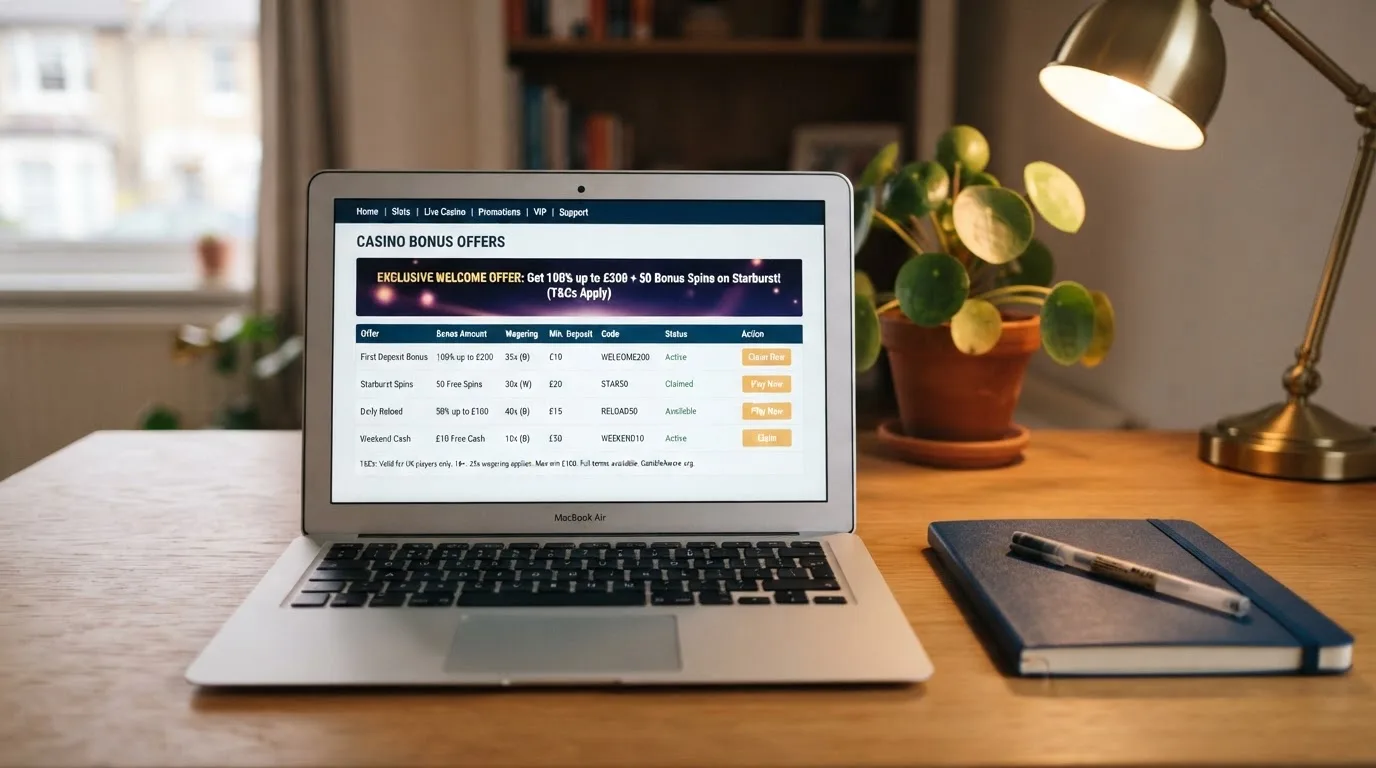
A bonus is usually a deposit match — the casino adds a percentage of the deposit as bonus money, up to a ceiling — or a fixed amount credited on a minimum deposit. Free spins are a third shape: a set of spins on a named slot, with any winnings paid as bonus money that carries its own wagering requirement. Several UK sites now advertise “no wagering free spins”, which is a different beast — the spin winnings land as cash rather than bonus — and is the closest the licensed market gets to a genuinely wager-free promotion. Both shapes are governed by the same 10x ceiling on the bonus amount, where it applies.
Two other numbers travel with every bonus and change its real cost. The first is eligible games: slots typically count 100% toward wagering, live casino and table games often count 10% or nothing, and a small number of high-RTP slots are excluded entirely. The second is max win from bonus: a cap on what the player can withdraw from bonus-derived funds, often £100 or £250 for no-deposit offers and variable for deposit offers. A 10x multiplier looks very different when paired with a £50 max win cap than when paired with no cap at all.
What the 10x cap actually covers
The 10x cap, in force since 19 December 2025, applies to the wagering requirements on deposit bonuses offered to GB-licensed customers. Mixed-product bonuses — a sportsbook bet that unlocks casino spins, for instance — were banned at the same time, closing a route that used to let one product subsidise another. Free spins, when paid as bonus funds, fall inside the 10x rule; free spins that pay cash winnings are unaffected, because there is no bonus to multiply. The cap applies per bonus, not in aggregate across an account: a player can run several bonuses at 10x in succession without breaching it.

What the cap does not do is shorten the playthrough itself. A £200 deposit bonus at 10x still requires £2,000 of qualifying stake, and at a £0.10 spin that is 20,000 spins — about 28 hours of continuous play at a 5-second spin interval. The cap lowers the multiplier; the volume of stake is governed by the size of the bonus and the stake per spin, not by the rule change.
What the Gambling Commission register looks like in 2026
Every GB-licensed online casino appears on the Gambling Commission’s public register, searchable online and downloadable as a CSV. On 18 September 2026 the register held 139 businesses holding an active remote casino operating licence. The register’s domain list, which records each website against the licence account that runs it, carried 1,065 active domains and a further 361 white-label entries — sites that trade under another company’s licence rather than holding their own.
A remote casino licence number on the register follows the pattern account-R-number-suffix. The leading six digits are the licence holder’s account number; the R marks a remote, online licence. A live example: MrQ sits on the register as an active domain of account 60629, Tek Fox Ltd, holding licence 060629-R-337532-004. Several brands can sit on the same licence: Paddy Power and Betfair both run on PPB Games Limited’s 039411-R-319335-010, and Gala Bingo runs under LC International Limited rather than as its own licensee. White-label sites, of which Virgin Games under Gamesys Operations Limited is one, are a recognised category on the register, not an exception.
The register is the only place to verify a licence. A site that quotes a UKGC licence number but does not appear on the register is not licensed, and a site that omits the number entirely should be treated as if it is unlicensed until proven otherwise.
Safer-gambling protections that come with the licence
A GB-licensed casino is not just a brand with a logo and a domain — it operates inside a fixed set of safer-gambling obligations that shape what a player can and cannot do with a bonus.
GAMSTOP is mandatory. Every online licence holder has been required to integrate GAMSTOP, the national online self-exclusion scheme, since 31 March 2020. Self-exclusion periods are six months, one year or five years and cannot be cancelled early. A player registered with GAMSTOP cannot open an account with any GB-licensed operator; a bonus is irrelevant if the scheme blocks the deposit in the first place.
Identity checks are not optional. Since 7 May 2019, name, address and date of birth must be verified before the first deposit or any play. Anonymous play is not available at a licensed site. A “no-deposit” bonus is no exception: the ID check still runs, the deposit is simply the bonus itself.
Deposit limits must be offered before the first deposit, since 31 October 2025. The Commission does not set a default ceiling — operators set their own — but every new customer must be prompted to set one before money moves. A player who already has a limit in place can adjust it, but only with a confirmatory cool-off.
Financial vulnerability checks trigger at £150 of net deposits in a rolling 30 days, in force since 28 February 2025. The check runs against public data only at present; wider financial risk assessments have been announced but are not yet live. A bonus-heavy account that hits this threshold without the player realising will see a check fire before the next deposit clears.
Slot stake limits apply regardless of the bonus. Players aged 25 and over are capped at £5 per game cycle since 9 April 2025; players aged 18-24 are capped at £2 per cycle since 21 May 2025. Auto-play is banned, a single spin takes at least 2.5 seconds, and losses disguised as wins are banned. Each of these is enforced at the game level, not at the bonus level.
Help is signposted. The National Gambling Helpline (run by GamCare) and GambleAware are the two main routes a GB-licensed site must point a player toward. The Commission itself runs an approved ADR route for disputes a player cannot resolve with the operator.
None of these protections follow a player to an offshore brand. A Curaçao, Maltese or Gibraltar licence is not a substitute for a UKGC licence for the GB market, and the Commission has no ISP-blocking power — it disrupts illegal sites through cease-and-desist notices, search-engine delisting and payment referrals, but the player who reaches an unlicensed site has none of the protections above.
Payments and how they shape the bonus
The credit-card ban has been in force since 14 April 2020 across every gambling product in Great Britain, including credit cards routed through e-wallets. Deposits at a GB-licensed casino are debit card, bank transfer or e-wallet — Apple Pay, PayPal, Skrill, Neteller, AstroPay, Trustly — depending on the operator’s cashier. The choice of payment method changes what counts as a qualifying deposit for a bonus: a deposit via Skrill or Neteller is often excluded from the headline offer, leaving the player with cash balance only.
Apple Pay is developed and operated by Apple Inc., launched on 20 October 2014 with US cards first, then UK cards from 14 July 2015. Card data is tokenised into a device-specific Device Primary Account Number with a dynamic security code per transaction. In-store payments run over NFC; in-app and web payments use a different flow. Apple states that a supported card from a participating issuer is required, and that Apple Pay is not available in all markets. On an iPhone with Face ID the side button is double-clicked to confirm; on Touch ID models the Home button is double-clicked instead.
AstroPay was founded in 2009 and is headquartered in Uruguay, operating as a global digital wallet offering online payments, virtual and physical debit cards and peer-to-peer transfers. Its UK entity, Larstal Limited, is authorised by the Financial Conduct Authority under the Electronic Money Regulations 2011; its Isle of Man entity is licensed by the Isle of Man FSA; its Brazilian entity is authorised by the Brazilian Central Bank as an electronic currency issuer; its Danish entity, Larstal Denmark ApS, is authorised by the Danish FSA. AstroPay serves markets including Argentina, Australia, Brazil, Canada, Colombia, Denmark, Spain, the UK, the US and Uruguay. In 2016 AstroPay spun off its payment-processing business as dLocal.
Bank transfer in the UK typically moves through the Faster Payments Service, launched in 2008 and operated by Pay.UK. The service runs 24 hours a day, seven days a week; most payments arrive instantly or within a couple of minutes, though transfers can occasionally take up to two hours. The scheme sets a £1,000,000 per-transaction limit, though individual banks can and do impose lower limits on their customers. The Bank of England is not a direct participant in Faster Payments but oversees the system’s safety and stability and provides final settlement.
Withdrawals sit on the same rails. A casino paying out via Faster Payments usually reaches the player’s bank account within minutes; a debit-card withdrawal runs one to three working days depending on the issuer. E-wallet withdrawals are typically faster than debit card but slower than Faster Payments in practice. The bonus-clearance step, where wagering has to finish before a withdrawal is honoured, adds its own delay: a player who takes the full bonus playthrough window will not see a payout until that window closes.
The bonus mechanics in plain prose
A £100 bonus at 10x needs £1,000 of qualifying stake to clear. At £0.10 per spin that is 10,000 spins, which at a 5-second spin interval runs about 13.9 hours of continuous play. At £0.20 per spin the same bonus clears in half the time on half the spins. At £0.50 per spin it is 2,000 spins, around 2.8 hours.
A £200 bonus at the same 10x ceiling takes £2,000 of stake. At £0.10 a spin that is 20,000 spins and roughly 27.8 hours of play. The 10x cap did not change the volume of stake a large bonus requires; it changed only what multiplier the casino is allowed to put on the bonus in the first place.
The expected loss from running a bonus at 10x on a 96% RTP slot is the turnover multiplied by the house edge: £1,000 of stake at 4% house edge is £40 of expected loss on a £100 bonus, and £80 on a £200 bonus. A 94% RTP slot at the same stake doubles that figure to £60 and £120. The bonus is paid for in expected loss during the playthrough, not in any single spin.
These figures are statistical averages over many spins under the stated assumptions, not guaranteed outcomes for any individual player. A session can finish ahead or behind the expected loss; over thousands of spins on the same slot the average converges on it. The casino does not promise a win, a payout or a return — only that the multiplier on the bonus is what it says.
The licensed operator set, side by side
Ten GB-licensed online casino brands appear in the comparison below. Each is taken from the Gambling Commission’s public register of gambling businesses: the domain is listed against the licence account that runs it, with the remote casino operating licence number. The order is the order of the feature set, not a recommendation. Several brands share a single licence: Paddy Power and Betfair both sit on PPB Games Limited’s 039411-R-319335-010, and Gala Bingo runs under LC International Limited’s 054743-R-330863-014 rather than as its own licensee.
| Brand | Licence holder | GB remote casino licence | Domain status on the register |
|---|---|---|---|
| MrQ | Tek Fox Ltd (account 60629) | 060629-R-337532-004 | Active |
| bet365 | Hillside (UK Gaming) ENC (account 55149) | 055149-R-331499-004 | Active |
| PokerStars | Stars Interactive Limited (account 39108) | 039108-R-319334-026 | Active |
| Paddy Power | PPB Games Limited (account 39411) | 039411-R-319335-010 | Active |
| Betfair | PPB Games Limited (account 39411) | 039411-R-319335-010 | Active |
| William Hill | WHG (International) Limited (account 39225) | 039225-R-319373-015 | Active |
| BetVictor | BV Gaming Limited (account 39576) | 039576-R-319370-028 | Active |
| Sky Vegas | Bonne Terre Gaming Limited (account 65519) | 065519-R-339675-002 | Active |
| Virgin Games | Gamesys Operations Limited (account 38905) | 038905-R-319430-022 | White-label |
| Gala Bingo | LC International Limited (account 54743) | 054743-R-330863-014 | Active |
The set spans the four licence-account groups that dominate the GB remote casino market: PPB Games (Paddy Power, Betfair), LC International (Gala Bingo alongside Ladbrokes and Coral, which are not in this comparison), Gamesys (Virgin Games as a white-label), and the rest of the larger single-brand operators. White-label status, as it applies to Virgin Games here, means the domain trades under another company’s licence rather than holding its own. Every entry holds an active or white-label listing as of 18 September 2026.
The comparison table above carries what the register carries. The bonus terms themselves — the wagering multiple, the eligible games, the max win cap — vary by operator and by promotion, and none of that variation is on the register. The register is the licence check, not the bonus check.
MrQ — a clean bonus structure on a small licensee
MrQ runs on Tek Fox Ltd’s account 60629, with MrQ listed as an active domain and licence 060629-R-337532-004. The brand has built its identity around plain-English bonus terms, and the site is the kind that publishes the wagering requirement in the same line as the bonus amount rather than in a linked terms page. For a player who wants to see the multiplier before clicking claim, MrQ is among the more readable options in the licensed set.
bet365 — the established heavy hitter
bet365 sits on Hillside (UK Gaming) ENC’s account 55149, with bet365 listed as active under licence 055149-R-331499-004. The brand is a sportsbook first and a casino second, and the casino bonus terms reflect that: a deposit match tends to come with a 10x multiplier on casino products and a tighter list of eligible games than a casino-only operator publishes.
PokerStars — casino on a poker-first licence
PokerStars runs on Stars Interactive Limited’s account 39108, with PokerStars listed as active under licence 039108-R-319334-026. The casino product is bundled with the poker vertical, and bonus offers typically tie casino play to activity elsewhere on the site. A player who already plays poker will find the bonus structure familiar; a player who only wants casino play will find the cross-vertical structure harder to evaluate.
Paddy Power and Betfair — one licence, two brands
Both Paddy Power and Betfair sit on PPB Games Limited’s account 39411 and licence 039411-R-319335-010. The shared licence is visible on the register but rarely on the site itself: each brand markets independently, with its own bonus terms and its own promotions calendar. A player who holds accounts at both should not assume the bonus terms move together — they do not, even though the operator behind them is the same.
William Hill — long history, current licence
William Hill sits on WHG (International) Limited’s account 39225, with William Hill active under licence 039225-R-319373-015. The brand is one of the older names in the GB market and the licence has been continuously held through the corporate restructurings of the last decade. Bonus offers tend toward the conservative end of the licensed market — modest deposit matches with multipliers at or close to the 10x ceiling rather than headline-grabbing amounts.
BetVictor — independent operator on its own licence
BetVictor runs on BV Gaming Limited’s account 39576, with betvictor active under licence 039576-R-319370-028. The brand is one of the few remaining independent names in the GB market, and the casino bonus structure is correspondingly standalone rather than part of a multi-brand portfolio. The 10x ceiling has brought its bonus terms closer to the rest of the market than they were before the rule change.
Sky Vegas — broadcaster-tied brand
Sky Vegas sits on Bonne Terre Gaming Limited’s account 65519, with Sky Vegas active under licence 065519-R-339675-002. The licence account is the youngest in this comparison by registration date, and the brand is bundled into the Sky customer proposition. Bonus offers tend to be tied to Sky account activity in some way; a player outside the Sky ecosystem will see a narrower set of promotions than a Sky TV or broadband customer.
Virgin Games — white-label under Gamesys
Virgin Games runs as a white-label domain under Gamesys Operations Limited’s account 38905 and licence 038905-R-319430-022. White-label status on the register means the domain trades under another company’s licence; Virgin-branded marketing sits on top of a Gamesys-built product. Bonus terms are set by Gamesys and inherited across the white-label portfolio rather than negotiated separately for the brand.
Gala Bingo — LC International’s casino-adjacent brand
Gala Bingo sits on LC International Limited’s account 54743, with Gala Bingo active under licence 054743-R-330863-014. The licence also covers Ladbrokes and Coral, neither of which is in this comparison; the brand itself is the bingo-rooted arm of the LC International portfolio. Casino bonus offers exist alongside the bingo product, and the bonus structure tends to favour bingo play over casino play in the eligible-games weighting.
Picking an offer: the cost is in the playthrough, not the headline
The licensed market is more uniform than it was before 19 December 2025. The 10x ceiling and the mixed-product ban have flattened the headline figures: a deposit match at 10x is the new normal, and the bonus amount is what operators now compete on rather than the multiplier. The player-facing difference has moved to eligible games, max win caps and the speed at which a bonus expires.
A player with a small bankroll should weight eligible games heavily. A £100 bonus at 10x is a £1,000 playthrough; on a 96% RTP slot that is £40 of expected loss, but on a 94% slot it is £60, and on excluded games it does not count at all. A player who wants to clear a bonus quickly should pick a stake that the 2.5-second spin minimum can sustain — pushing the stake higher compresses the play time but raises the expected loss per spin in equal proportion. A player who wants the highest chance of ending ahead should look for free spins that pay cash, not bonus, because the cash path has no wagering requirement at all.
The bonus is information, not an instruction. The licensed market in 2026 is a small set of brands under a fixed set of rules; what changes between them is the small print, and the small print is what the bonus is worth.
Frequently Asked Questions
What counts as a low wagering requirement on a UK casino bonus?
In the GB-licensed market a “low” wagering requirement sits at or below the 10x ceiling that took effect on 19 December 2025, applied to the bonus amount only and not to the deposit. Anything above 10x is no longer permitted on a deposit bonus at a GB-licensed site. Free spins that pay cash rather than bonus have no wagering requirement and are the lowest of all.
Has the UK’s wagering cap on deposit bonuses changed recently?
Yes. Since 19 December 2025 the Gambling Commission has capped deposit-bonus wagering at 10x the bonus amount and banned mixed-product bonuses that pair a sportsbook bet with casino credit. The cap applies per bonus, not in aggregate, and several successive 10x bonuses can run on the same account without breaching it.
Can a no-deposit bonus also carry low wagering?
Yes. The 10x ceiling applies to deposit bonuses specifically; no-deposit bonuses are governed by their own terms, which often sit higher than 10x and frequently include a max-win cap. No-deposit offers in the GB-licensed market should be read for both the multiplier and the cap, because the cap can dwarf the bonus amount.
Does a lower wagering requirement usually mean a smaller bonus amount?
Often, but not always. Before the 19 December 2025 cap, higher multipliers were routinely paired with larger bonus amounts to flatter the headline; the cap has compressed that gap. In the current market the bonus amount and the multiplier move more independently than they used to, and a small bonus at 10x can be a better value than a large bonus at 10x with a tight eligible-games list.
Are low wagering bonuses restricted to certain games?
Almost always. Slots typically count 100% toward wagering; live casino and table games often count 10% or nothing; some high-RTP slots are excluded entirely. A bonus that clears in 13 hours on slots can take 130 hours on live casino, and the eligible-games list is the single biggest determinant of real cost after the multiplier itself.
How is wagering requirement calculated on a deposit bonus?
Required turnover equals the bonus amount multiplied by the wagering factor. A £100 bonus at 10x requires £1,000 of qualifying stake. Only the bonus, not the deposit, is multiplied. Some sites exclude certain deposit methods from qualifying for the bonus, and Skrill or Neteller deposits are often on that excluded list.